

The World Wide Web is My Parish – Zoom Edition(part 1)

•July 6, 2020 • 4 Comments
Difference between Internet and Web - WWW and its services | Websites Management | The Internet is a network of connected devices that covers the entire world. The Web is a service that supports it, such as browsers, emails, FTP, etc

There is now a video version of this blog available at:

Twenty one years ago, as part of my ministerial training, I wrote my dissertation.  It was called ‘The World Wide Web is My Parish’. Focused on whether and how churches should be using the, then relatively new to general use, internet.  At that time the big question was mainly about churches having websites, whether they should and if they did how they used them – was it mainly as a notice board, or for interaction.

All these years later, the internet is a very different place and the advent of social media has brought much more space for the church to consider how it uses.  And in 2020 a global pandemic has brought a whole new slant, opportunity and, for some, questions. Zoom worship is now a pretty established thing that has, in my opinion, been a great blessing to the church, particularly as it has the ability for people to phone in to via a landline phone, which means most of the population of the UK could access it.  How awesome it has been in a time of isolation to be able to ‘meet’ together, to share fellowship with one another and to worship God together.

But as lookdown eases and the possibility of churches re-opening their buildings for worship, even with restrictions, the question is raised of what happens to zoom worship. Perhaps now is the time to look at some theology of online and our place in it…

In June 1739, John Wesley wrote in his journal:

“I look upon all the world as my parish. I mean, that, in whatever part of it I am, I judge it, meet, right and my bounden duty to declare unto all that are willing to hear, the glad tidings of salvation.  This is the work that I know God has called me to; and sure I am that His blessing attends it.”

Jesus parting words to his disciples, which includes us, were:

“Jesus drew near and said to them, “I have been given all authority in heaven and on earth. Go, then, to all peoples everywhere and make them my disciples: baptise them in the name of the Father, the Son, and the Holy Spirit, and teach them to obey everything I have commanded you. And I will be with you always, to the end of the age.” Matthew 28:18-20

Online, in all its forms, whether we like it or not, is very much a part of our world, and therefore an entirely legitimate place to be in worship, mission, discipleship.

In his book Mission and Dialogue, Michael Nazir-Ali reminds us that the Church is called to “proclaim the gospel afresh in every age”  Part of being christian and being church is to live out our experience of God where we are, within our community.  To do this the church needs to be a part of its community and not hide in a “holy huddle” in the safe place.  If we are to bring the gospel to the world we have to be where the people are. 

Historically Methodism plays its part by breaking out of imposed structures and boundaries, when necessary, to be where people are.  John Wesley left the buildings and preached in the streets and fields to reach people.  To believe in God incarnate is to want to see the church incarnate in the world, not just clinging to its familiar ways.  Unless we express church in a way our community understands, we are failing to be Christ’s body to them.

We could question if there is is a need to liberate Jesus from clutches of a church focussed on institutional buildings, so that he can be experienced and encountered anew for each generation – relevant to their experience and understanding.

Throughout history, particularly by the church, there have been profound misgivings about machines and technology and the effect they may have on the social and spiritual wellbeing of the nation. The printing press and television were both seen as highly dubious in their time!

Frank Wright in his book, The Pastoral Nature of Ministry asks the pertinent question if we have so conceptualised faith that we have forgotten it is primarily an invitation to see (1980, p15)? Have we become to hung up on our buildings that we forget what God can do, or even that he exists outside them?  Buildings very much have their place, but they are not the only place. For the Church to fulfil its mission, it has to be changed and learn new things (as Leslie Newbigin asks in his book The Gospel in a Pluralist Society, 1989, p124), not to move from its core foundation and principles, but reinterpret the way it expresses them.  The church can join the search for new community, taking its place in it, and not missing its voice in the discussion. 

The Church is a place for people searching for truth, love, peace and wholeness.  We have that to offer and should seek to make that offer in any place where people are.  Online is such a significant part of the lives of so many people, the first place to which they turn.  The church is failing to fulfil its mission to go into all the world if it is not in that part of technology that covers the whole world, regardless of any political, geographical or physical boundaries.

In part 2, I will follow up with questions about where we are today, what lockdown has taught the churches about an online presence and where we go from here.

We pray Lord
for those whose lives have been so upset
by the Corona virus pandemic,
those whose certainties and sureties
have been taken away.

We pray for those isolated,
who feel that they have lost their community,
those who feel that they have lost what they held dear,
those who have lost their routine
and those who feel they have lost their connection with you.

We thank you Lord for all the ways we have been able to connect
whilst being aware that those ways are not for everyone,
but we thank you for the gift and the blessing that we have found
in services in Facebook Live, zoom, in the Daily Devotions,
in things that we have time to read,
that we wouldn’t have had time for before.

Thank you Lord
for meeting us in so many ways,
in the place where we have found ourselves.

We pray that you will continue to bless us,
that you will continue to meet with us,
as we begin to be able to meet together as we are able
and for those who still want to meet online.

We pray for all those seeking to find a place
where they can meet you
and know the reality of you.

We pray
not just for those who know and love you
but for those who are seeking
and for those who don’t even know
they are looking,
may they encounter you
in the place and in a way that they need to,
that all the world may know,
that all the world will hear,
that all the world may fall in love with you.

For we ask it in Jesus name

Amen
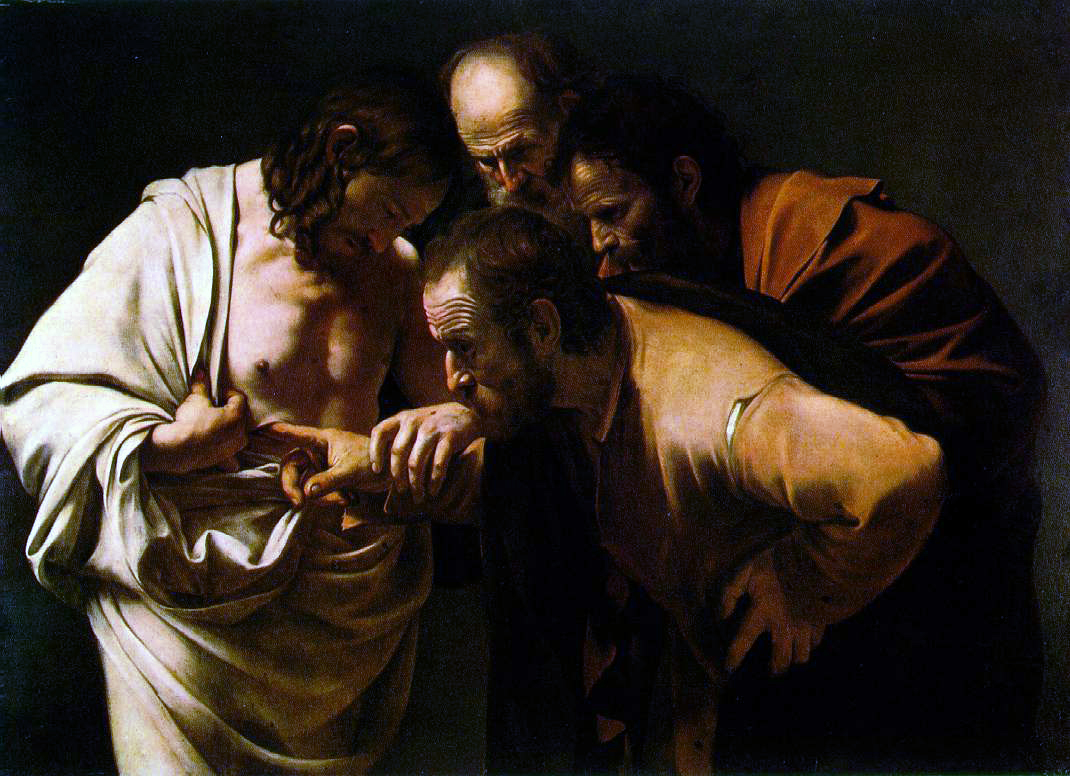
My Lord and My God

•July 3, 2020 • Leave a Comment

Today is celebrated as the feast day of Thomas, he of doubting fame.  So several lockdown weeks after Easter, we find ourselves back in the upper room and remembering Thomas, who thought he had missed out, missed meeting Jesus, missed seeing what God had done, missed his opportunity to know God and believe. (Created for our Circuit Daily Devotions – click on the link or here if you want to hear me croak my way through it!)

Caravaggio_Doubting_Thomas

John 20:24-29

Jesus and Thomas

24 Although Thomas the Twin was one of the twelve disciples, he wasn’t with the others when Jesus appeared to them. 25 So they told him, “We have seen the Lord!”

But Thomas said, “First, I must see the nail scars in his hands and touch them with my finger. I must put my hand where the spear went into his side. I won’t believe unless I do this!”

26 A week later the disciples were together again. This time, Thomas was with them. Jesus came in while the doors were still locked and stood in the middle of the group. He greeted his disciples 27 and said to Thomas, “Put your finger here and look at my hands! Put your hand into my side. Stop doubting and have faith!”

28 Thomas replied, “You are my Lord and my God!”

29 Jesus said, “Thomas, do you have faith because you have seen me? The people who have faith in me without seeing me are the ones who are really blessed!”

They were all so excited,
they had seen Jesus
actually been in his presence
seen the scars,
yet also him walking and talking,
heard his voice
sending
and equipping.

And I missed it.

I wasn’t there
when Jesus came to all the rest
I missed that precious experience
of seeing,
hearing
and touching Jesus
again.

I hear of what you do and say
but haven’t know it for myself.

How can I know it was true?
How can I feel it in my soul?
How can I believe,
when I haven’t seen,
experienced,
touched
for myself?
How can I know?

I just can’t grasp it.

You tell me he’s alive,
that you’ve seen him,
but that’s not working
for me.

I saw him die,
I know he’s dead.
Your experience says different,
but I’m just not getting it.

I need to know,
I need to see,
to touch
and be touched.

Some how that seems weak,
my faith dependent on seeing
not believing,
but that’s what I need.

~~~

Oh how you know me Lord,
you know what I need
and you supply.

You allow me to see,
to touch,
to know.

How I wish I had the faith
to just believe,
but now
in reaching out
and touching
I know.

I believe.

You are alive

and you come to me
where I am,
how I am,
knowing what I my need
and meeting it.

You invite me to reach out
to you.

And so
I come to you.

Thank you Lord,
for your presence,
your risen presence.

Thank you for not
writing me off,
but coming to me.

Thank you
that you are there,
whether I feel
I can reach you
or not,
ever present,
in my life,
in your world.

Thank you for meeting me
when I find it hard to believe
or easy;
when I think I have missed out
or have been there for it all;
whether I have missed other opportunities to know you
or am taking this my first
– today Lord,
I see you,
feel you,
touch your presence
and I believe.

May I know that today,
however,
wherever I am.

Help me to believe.

You are My Lord
and My God.


We pray for those who are seeking,
searching,
longing:

Lord
as we long to see you
may we find you.
may we know your presence
and reality
in our lives.

If we feel that we have missed out
before today
May today be the day
when we meet you
and encounter you,
when we touch you,
when you invite us
to touch you
and to know you.

Bless us Lord
each one of us where we are
that we may believe
and know


The Lord Provides

•June 26, 2020 • Leave a Comment

God Commands Abraham to Offer Isaac

22 Some time later God tested Abraham; he called to him, “Abraham!” And Abraham answered, “Yes, here I am!”

“Take your son,” God said, “your only son, Isaac, whom you love so much, and go to the land of Moriah. There on a mountain that I will show you, offer him as a sacrifice to me.”

Early the next morning Abraham cut some wood for the sacrifice, loaded his donkey, and took Isaac and two servants with him. They started out for the place that God had told him about. On the third day Abraham saw the place in the distance. Then he said to the servants, “Stay here with the donkey. The boy and I will go over there and worship, and then we will come back to you.”

Abraham made Isaac carry the wood for the sacrifice, and he himself carried a knife and live coals for starting the fire. As they walked along together, Isaac spoke up, “Father!”

He answered, “Yes, my son?”

Isaac asked, “I see that you have the coals and the wood, but where is the lamb for the sacrifice?”

Abraham answered, “God himself will provide one.” And the two of them walked on together.

When they came to the place which God had told him about, Abraham built an altar and arranged the wood on it. He tied up his son and placed him on the altar, on top of the wood. 10 Then he picked up the knife to kill him. 11 But the angel of the Lord called to him from heaven, “Abraham, Abraham!”

He answered, “Yes, here I am.”

12 “Don’t hurt the boy or do anything to him,” he said. “Now I know that you honor and obey God, because you have not kept back your only son from him.”

13 Abraham looked around and saw a ram caught in a bush by its horns. He went and got it and offered it as a burnt offering instead of his son. 14 Abraham named that place “The Lord Provides.”  And even today people say, “On the Lord‘s mountain he provides.”


Reading this passage at face value, it is very difficult, really problematical.  God asking someone to sacrifice their much longed for and God-given gift.  Has God changed his mind?  Is he so cruel as to do that?  To ask for a child back?  This is not the kind of God I think I know and believe in.

What kind of father would do that to his son?  To go as far as to actually tie him up and lay him on the altar?  Was he deranged, lost all perspective, so caught up in religious mania?

What is this story doing in the bible?  Can it actually have anything to teach us?

We read the unfolding tale knowing what the ending is.  Ultimately Abraham goes on to take Isaac home with him, who goes on to be father of Jacob, and grandfather of the Twelve Tribes of Israel. I guess we don’t know how his life would have gone without this experience?

We can read it through a New Testament lens of God’s sacrifice of his own Son.  But that is not how it would have been for Abraham, or Isaac, as they live this experience, or for those first reading it.  They set out on this journey of faith.  Abraham clearly believed that God was going to do something different, because he told the men “We will be back”, but I don’t suppose he actually knew until it happened.

Just to be clear, I don’t for one minute think that God gives us things and ‘asks for them back’ or just takes them back.  Yes things happen and things and people that we treasured are taken from our lives – but never, ever by God.  See how complex this passage is…

So, I wanted to try and put myself in Abraham’s shoes as he walks this walk to Mount Moriah, his beloved Isaac by his side.  What did he think God was doing and saying – and what might it have to say to us?

I thought I had it all,
everything I’d ever wanted,
even what you promised me,
waited so long for,
and now…

You are asking me to give it up,
surrender,
sacrifice,
offer it back to you.

My most precious thing.
not just mine
but the whole family,
everyone involved.

What am I to do?
It is your gift to me,
I love him.

And there he is,
trotting along beside me –
Isaac,
my amazing son,
longed for love of my life,
trustingly,
quite literally putting his life in my hands.

How can I let him go,
my life,
my future
and the future you promised for me
and the generations to come?

Did you not mean your promise?
Was it just this –
so far and no further?
Is there a greater plan?
Do you have something else in mind?
Something I don’t understand?

So here I am Lord,
here we are,
walking as you asked,
coming to where you called us.
In fear,
in trepidation,
in hoping
that this time
I’ve got it very wrong,
that this is not what you are asking.

But I am here

And I trust that you will provide
as you always have
and you always will.

What is my most precious thing Lord?

What do I cling to
hold tightly to me,
prize above all things?

What have you given me
that fulfils my purpose
and calling?

What am I so thankful to you for?

And yet
I have to ask
if there is anything you are asking me to give you?
Not for you to destroy it,
take everything away,
but so I can receive it back
maybe in a changed way,
a new way,
a stronger way,
your way.

Help me to make sense
of the gifts you have given me
and what you want me to do with them.

To see
and understand
what you provide