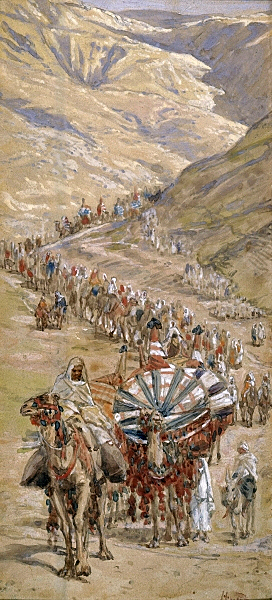
4-5 Abram was seventy-five years old when the Lord told him to leave the city of Haran. He obeyed and left with his wife Sarai, his nephew Lot, and all the possessions and slaves they had gotten while in Haran.
When they came to the land of Canaan, 6 Abram went as far as the sacred tree of Moreh in a place called Shechem. The Canaanites were still living in the land at that time, 7 but the Lord appeared to Abram and promised, “I will give this land to your family forever.” Abram then built an altar there for the Lord.
8 Abram traveled to the hill country east of Bethel and camped between Bethel and Ai, where he built another altar and worshiped the Lord. 9 Later, Abram started out toward the Southern Desert.
Is it here?
Is this the place?
Is this where you are calling me to?
Is this the person I am to become?
This is a journey.
There are important stages on the way,
but they are not the destination.
Perhaps junctions,
maybe places to wait for a connection.
important places on their own,
but not The Place.
Somewhere to pause,
think,
pray.
An opportunity to check the map,
the timetable,
or ask in the information office,
but not a forever place.
But The Now place.
the place we are,
the place God is
This year, several of us are reading Beginnings and Endings by Maggi Dawn and joining together to comment on it. Do join us at the Adventbookclub Facebook page, follow #adventbookclub on Twitter or comment below. If you are also reading and blogging on this book, let me know and I will link to your blog.
31 Terah decided to move from Ur to the land of Canaan. He took along Abram and Sarai and his grandson Lot, the son of Haran. But when they came to the city of Haran, they decided to settle there instead. 32 Terah lived to be two hundred five years old and died in Haran.
The Lord Chooses Abram
12 The Lord said to Abram:
Leave your country, your family, and your relatives and go to the land that I will show you. 2 I will bless you and make your descendants into a great nation. You will become famous and be a blessing to others. 3 I will bless anyone who blesses you, but I will put a curse on anyone who puts a curse on you. Everyone on earth will be blessed because of you.
4-5 Abram was seventy-five years old when the Lord told him to leave the city of Haran. He obeyed and left with his wife Sarai, his nephew Lot, and all the possessions and slaves they had gotten while in Haran.
When they came to the land of Canaan,
How nice it is, usually, to be chosen, selected, picked out. A feeling of being special, “The One”, lined up for something. We like to be chosen, it makes us feel valuable.
But I wonder how Abram felt here about being chosen by God? Leave your home, your wider family, all that is familiar – and come on a journey with me. I think my response would be along the lines of, ‘Well, thank you Lord, but that sounds really rather scary, quite uncomfortable and fraught with difficulty. Perhaps on this occasion I’d rather not be chosen – and stay here.’ Actually I’m sure I’ve said that to God before when he’s invited me to come with him.
Maggi gives some wise advice on hearing and discerning “a call” (p41).
God chooses each one of us. He invites us to come with him. To journey. To calling. To blessing. It is not just for Patriarchs, Prophets and Priests, it for us all.
Someone gave us this when God was shouting at me about full-time Presbyteral Ministry (which is emphatically not the only call…), and I was choosing not to hear very well
Who us?
And the Lord said, “Go!”
And we said, “Who us?”
And he said, “Yes, you”.
And we said,
“But we’re not ready yet
And there’s company coming.
And we can’t leave the kids,
And you know there is no-one to take our place.”
And he said, “You’re stalling”.
Again the Lord said, “Go”.
And we said,
“But we don’t want to”.
And we said,
“Listen, we’re not that kind of people
To get involved so deeply,
besides
Our family wouldn’t like it.
And what will the neighbours think?”
And he said, “Baloney”.
And yet a third time the Lord said, “Go!”
And we said, “Do we have to?”
And he said, “Do you love me?”
And we said,
“Look, we’re scared.
People are going to reject us.
And cut us up into little pieces.
And we can’t take it all by ourselves.”
And he said, “Where do you think I’ll be?”
And the Lord said, “Go!”
And we sighed, “Here we are Lord, send us”.
Sometimes you just have to stop arguing with God, and go with him!
That’s something he calls us all to do. The direction for each of us may be different, but God has chosen each of us for something. None of that embarrassing waiting in a line to be picked like in PE lessons…
God has chosen you. Will you let him? Will you go with him?
Maggi reminds us that hearing a call is a beginning of a journey – not a final destination, or even knowing where that final destination is (if we knew we may well decide to stay firmly put :)) Hearing God’s call and responding is about being willing to start out on the journey.
And this I love,
The call of God seems to involve choosing what to take and what to leave behind and the willingness to do the sorting out and packing up that makes moving possible (p42)
That is vital as we continue the journey and discovery of our call – what comes with us and what stays behind?
Thank you Lord
for choosing me,
for having something
uniquely me shaped,
a task you need me for.
Lord,
when I stall,
dither,
question,
and drag my feet,
may I hear
with clarity
your call
and be brave enough to follow.
This year, several of us are reading Beginnings and Endings by Maggi Dawn and joining together to comment on it. Do join us at the Adventbookclub Facebook page, follow #adventbookclub on Twitter or comment below. If you are also reading and blogging on this book, let me know and I will link to your blog.
8 Late in the afternoon a breeze began to blow, and the man and woman heard the Lord God walking in the garden. They were frightened and hid behind some trees.
The Trouble with Sin
9 The Lord called out to the man and asked, “Where are you?”
10 The man answered, “I was naked, and when I heard you walking through the garden, I was frightened and hid!”
11 “How did you know you were naked?” God asked. “Did you eat any fruit from that tree in the middle of the garden?”
12 “It was the woman you put here with me,” the man said. “She gave me some of the fruit, and I ate it.”
13 The Lord God then asked the woman, “What have you done?”
“The snake tricked me,” she answered. “And I ate some of that fruit.”
14 So the Lord God said to the snake:
“Because of what you have done, you will be the only animal to suffer this curse— For as long as you live, you will crawl on your stomach and eat dirt. 15 You and this woman will hate each other; your descendants and hers will always be enemies. One of hers will strike you on the head, and you will strike him on the heel.”
16 Then the Lord said to the woman,
“You will suffer terribly when you give birth. But you will still desire your husband, and he will rule over you.”
17 The Lord said to the man,
“You listened to your wife and ate fruit from that tree. And so, the ground will be under a curse because of what you did. As long as you live, you will have to struggle to grow enough food. 18 Your food will be plants, but the ground will produce thorns and thistles. 19 You will have to sweat to earn a living; you were made out of soil, and you will once again turn into soil.”
Maggi describes this passage as
The end of the beginning (p34)
and it is. God has spent his time creating a perfect world, leaves man and woman to care for it, and what happens? Pretty soon the one rule they had is broken. And very quickly follows blame – “She made me do it” (v12), and “the snake tricked me”.
They had both heard what God said,
God said we could eat fruit from any tree in the garden, except the one in the middle. He told us not to eat fruit from that tree or even to touch it. If we do, we will die. (v3)
and so both were responsible, but both chose to blame someone else. There was no personal responsibility.
And the consequences reverberate down through the generation…
The passage starts off so beautifully – an afternoon breeze and God walking in the garden. But the mood quickly changes as they know they have done wrong and scuttle off to hide.
Have you ever wanted to hide from God? To know he is there and be so ashamed of yourself that you wished you could scuttle off? I know I have. That point of realisation – I’m not as good as I’d like to think, I’m not the persona I like to project, there is very little of paradise in me…
That point can be the end of the beginning of our relationship with God, but the beginning of an honest one.
This passage is reality. It is where we are, or certainly where we begin with God. It is the end of the beginning, but the beginning of something new. From knowing where we are, we can move on.
As Maggi says, we know the problem (p37). Now, we begin to find out what God is going to do about it for us.
Lord,
in my reality,
I want to hide from you.
I know what I have done wrong,
and I am ashamed to face you.
I try to blame others,
but I have no one to blame but myself.
I am in trouble,
and I know it.
Yet I cannot hide from you,
for only you can help me
This year, several of us are reading Beginnings and Endings by Maggi Dawn and joining together to comment on it. Do join us at the Adventbookclub Facebook page, follow #adventbookclub on Twitter or comment below. If you are also reading and blogging on this book, let me know and I will link to your blog.