

Good News #adventbookclub – Day 6

•December 6, 2013 • Leave a Comment

Mark 1:1-11 (CEV)

The Preaching of John the Baptist

This is the good news about Jesus Christ, the Son of God. It began just as God had said in the book written by Isaiah the prophet,

“I am sending my messenger
to get the way ready
    for you.
In the desert
    someone is shouting,
‘Get the road ready
    for the Lord!
Make a straight path
    for him.’”

So John the Baptist showed up in the desert and told everyone, “Turn back to God and be baptized! Then your sins will be forgiven.”

From all Judea and Jerusalem crowds of people went to John. They told how sorry they were for their sins, and he baptized them in the Jordan River.

John wore clothes made of camel’s hair. He had a leather strap around his waist and ate grasshoppers and wild honey.

John also told the people, “Someone more powerful is going to come. And I am not good enough even to stoop down and untie his sandals. I baptize you with water, but he will baptize you with the Holy Spirit!”
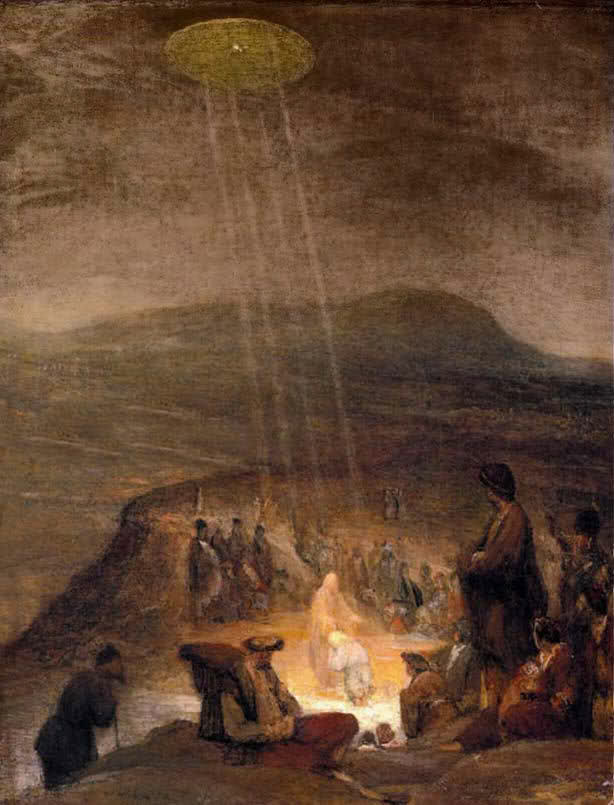
The Baptism of Jesus

About that time Jesus came from Nazareth in Galilee, and John baptized him in the Jordan River. 10 As soon as Jesus came out of the water, he saw the sky open and the Holy Spirit coming down to him like a dove. 11 A voice from heaven said, “You are my own dear Son, and I am pleased with you.”

I’ve probably had too much Top Gear inflicted on me, but whenever I hear the phrase ‘Good News’, I think of this:

Good news is something to get excited about, something to rejoice in, to celebrate.

God had promised, the way would be prepared, and now it has been.  He’s here.

I don’t know about you, but in our house the excitement levels always increased when someone exciting or special was expected.  Much checking through the window, and then excited cries, “He’s here”.

Mark’s gospel always seems to be excited, keen to tell you everything in a great rush, because it’s so incredible, so exciting, such Good News.  He doesn’t go into the ancestry or even birth of Jesus, he wants to get on with the main event, what Jesus came to do.  That doesn’t mean his origins aren’t important, just not part of what Mark has to say.

Maggi points us to Mark’s two questions (p32):

Who is Jesus?

What should a disciple of Jesus be like

The answers to those questions are what concern him, and continue to be the basis for Christian life – what we need to discover and live out.  Advent is an opportunity for us to ponder those questions anew.

Who is Jesus?  What does he mean for me, where I am in my life today?  And how do I respond?  What should my life look like to live out what I believe?

A warning note from Maggi, that though we have to answer those questions for ourselves, the answers have to remain part of the bigger picture, brought to us through the prophets.

Long Ago Prophets Knew

Who are you?
What do you mean in my life?
These are the questions I have to ask myself.

Help me Lord,
to take time,
to listen,
to pray,
to live
– in you
and through you

(By the way, all this talk of the beginnings of the gospels reminds me of a brilliant book – Beginnings by Morna Hooker from SCM Press.  It puts each Gospel into context of where the author was going, how the beginning sites it.  Probably the best book I read during my theological training!)

This year, several of us are reading Beginnings and Endings by Maggi Dawn and joining together to comment on it.  Do join us at the Adventbookclub Facebook page, follow #adventbookclub on Twitter or comment below.  If you are also reading and blogging on this book, let me know and I will link to your blog.
 

Where Do I Come From? #adventbookclub – Day 5

•December 5, 2013 • 2 Comments

The Ancestors of Jesus

Jesus Christ came from the family of King David and also from the family of Abraham. And this is a list of his ancestors. 2-6a  From Abraham to King David, his ancestors were:

Abraham, Isaac, Jacob, Judah and his brothers (Judah’s sons were Perez and Zerah, and their mother was Tamar), Hezron;

Ram, Amminadab, Nahshon, Salmon, Boaz (his mother was Rahab), Obed (his mother was Ruth), Jesse, and King David.

6b-11  From David to the time of the exile in Babylonia, the ancestors of Jesus were:

David, Solomon (his mother had been Uriah’s wife), Rehoboam, Abijah, Asa, Jehoshaphat, Jehoram;

Uzziah, Jotham, Ahaz, Hezekiah, Manasseh, Amon, Josiah, and Jehoiachin and his brothers.

12-16 From the exile to the birth of Jesus, his ancestors were:

Jehoiachin, Shealtiel, Zerubbabel, Abiud, Eliakim, Azor, Zadok, Achim;

Eliud, Eleazar, Matthan, Jacob, and Joseph, the husband of Mary, the mother of Jesus, who is called the Messiah.

17 There were fourteen generations from Abraham to David. There were also fourteen from David to the exile in Babylonia and fourteen more to the birth of the Messiah.

If you set off to read the New Testament from beginning to end (see what I did there!), this is where you would start.  I remember doing this on being given a New Testament, probably when I was about eleven.  I confess I was bored long before I got to verse 17.  I am not a historian, and none of this meant anything to me.

In recent years we have seen increased interest from people in where they come from.  Lots of people are now trying to trace their family trees, and the BBC programme Who Do You Think You Are seems to have become a favourite.  Whether this is because we are more displaced from our families than ever before, I don’t know.  Once we lived the family history as we all lived together, now it is not so evident.

But here is God’s history, laid out before us.

Matthew clearly thinks it is important to place Jesus in the correct historical context, to place where he comes from.

In the words of Fred Pratt Green,

God in time, God in man,
This is God’s timeless plan:

Maggi points us to the differences between Luke’s and Matthew’s lists (p29).  Luke’s is about context, Matthew’s is the place he starts. Luke’s a personal story, Matthew’s a salvation history.

This brings me back to one of my pet themes.  Not everyone learns the same way, not everyone hears the same way, not everyone experiences the same way.  Some of us need story rooted in people, some of us need history rooted in fact – but both take us to the same place.  To the God who loves us and was and is working in people’s lives, through history and story – for both are the same, expressed in different ways.

We all experience God in different ways, we all come to him differently – with a different focus, story, understanding – but all to the one God.  We all bring different facets – and all are valuable and meet to create a fuller picture.

God’s story, working through time, working through us.

God’s plan was clear

Thank You God,
that there is not one way to experience you,
to know you,
to meet you,
but that you come to me
where I am,
in a way I can grasp.

Thank you for the ways others know you
that together
we can bring a bigger picture of you,
for you are bigger than any of us can hold,
deeper than any one of us can know.

May we share you,
as we know,
that more may come to experience you
in a way that makes sense to them.

This year, several of us are reading Beginnings and Endings by Maggi Dawn and joining together to comment on it.  Do join us at the Adventbookclub Facebook page, follow #adventbookclub on Twitter or comment below.  If you are also reading and blogging on this book, let me know and I will link to your blog.
 

One of Us #adventbookclub – Day 4

•December 4, 2013 • 3 Comments

Luke 3:21-38 (CEV)

The Baptism of Jesus

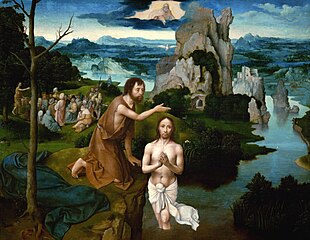
21 While everyone else was being baptized, Jesus himself was baptized. Then as he prayed, the sky opened up, 22 and the Holy Spirit came down upon him in the form of a dove. A voice from heaven said, “You are my own dear Son, and I am pleased with you.”

I, Davezelenka [GFDL (http://www.gnu.org/copyleft/fdl.html), CC-BY-SA-3.0 (http://creativecommons.org/licenses/by-sa/3.0/) via Wikimedia Commons

The Ancestors of Jesus

23 When Jesus began to preach, he was about thirty years old. Everyone thought he was the son of Joseph. But his family went back through Heli, 24 Matthat, Levi, Melchi, Jannai, Joseph, 25 Mattathias, Amos, Nahum, Esli, Naggai, 26 Maath, Mattathias, Semein, Josech, Joda;

27 Joanan, Rhesa, Zerubbabel, Shealtiel, Neri, 28 Melchi, Addi, Cosam, Elmadam, Er, 29 Joshua, Eliezer, Jorim, Matthat, Levi;

30 Simeon, Judah, Joseph, Jonam, Eliakim, 31 Melea, Menna, Mattatha, Nathan, David, 32 Jesse, Obed, Boaz, Salmon, Nahshon;

33 Amminadab, Admin, Arni, Hezron, Perez, Judah, 34 Jacob, Isaac, Abraham, Terah, Nahor, 35 Serug, Reu, Peleg, Eber, Shelah;

36 Cainan, Arphaxad, Shem, Noah, Lamech, 37 Methuselah, Enoch, Jared, Mahalaleel, Kenan, 38 Enosh, and Seth.

The family of Jesus went all the way back to Adam and then to God.

If ever there was proof that Jesus was one of us…

Jesus joins in, he is baptised.  He doesn’t sit and watch others do it, he takes part too.  He joins with what they are doing.

And then we have his ancestry, his family line.  This is where Jesus has come from, who he is.

If ever there was proof that Jesus was God…

At his baptism the public recognition, a statement by God,

This is my own dear son

And in his family line, traceable “All the way back to Adam,

And then to God

This is no upstart, no charlatan, no fly-by-night imposter.  This is God, here, living with us, in a human form.

God was, and is, one of us.  Living the life we live, showing us his way to do it.

When we wonder at things, and wonder what God would do, we can look at Jesus and his life.  When we ask, but what if God were here – he is.  Here for each and every one of us, here with each one of us, in the lives that we lead day by day.  His presence is woven through the history of humanity, and it is woven through our history.

Jesus brings God to it, brings

wholeness, healing and completeness (p27)

What if God Were One of Us?

Thank You God,
for being One of Us,
coming to the world,
showing us your ways
in the life of Jesus.

Thank you for being willing to become like us
that we might see and understand
what your ways are.

Help me
to follow your example,
to learn to live your ways,

This year, several of us are reading Beginnings and Endings by Maggi Dawn and joining together to comment on it.  Do join us at the Adventbookclub Facebook page, follow #adventbookclub on Twitter or comment below.  If you are also reading and blogging on this book, let me know and I will link to your blog.