Running Away #adventbookclub – Day 12

•December 12, 2013 • 2 Comments

Elijah Runs Away from Ahab and Jezebel

19 Ahab told his wife Jezebel what Elijah had done and that he had killed the prophets. She sent a message to Elijah: “You killed my prophets. Now I’m going to kill you! I pray that the gods will punish me even more severely if I don’t do it by this time tomorrow.”

Elijah was afraid when he got her message, and he ran to the town of Beersheba in Judah. He left his servant there, then walked another whole day into the desert. Finally, he came to a large bush and sat down in its shade. He begged the Lord, “I’ve had enough. Just let me die! I’m no better off than my ancestors.” Then he lay down in the shade and fell asleep.
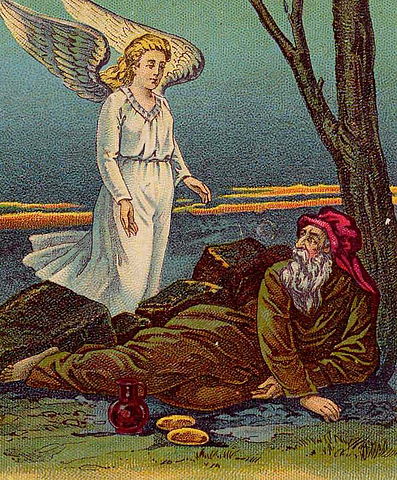
Suddenly an angel woke him up and said, “Get up and eat.” Elijah looked around, and by his head was a jar of water and some baked bread. He sat up, ate and drank, then lay down and went back to sleep.

Soon the Lord’s angel woke him again and said, “Get up and eat, or else you’ll get too tired to travel.” So Elijah sat up and ate and drank.

The food and water made him strong enough to walk forty more days. At last, he reached Mount Sinai, the mountain of God, and he spent the night there in a cave.

Now Elijah is not so brave….  When he realises the consequences of his actions, he runs away.

I have a lot of sympathy for Elijah.  He’s done the grand thing, shown how great God is, and then somehow has ended up killing the prophets of Baal.  From a mighty triumph, to a place of anger, murder and shame.  He soon finds himself wandering the desert.

I don’t know if you’ve ever run away, physically or metaphorically.  I have.  Not so much from God, but from life.  I ran away to the seaside, which was just what I needed for restoration, refocusing and the strength to carry on.

Elijah ran to the desert.  I’m sure that was not just literally.  That was where God met him and restored him body and soul (p60).

In the desert Elijah finally collapsed, completely exhausted and in absolute despair.

And here God met him in his moment of need.

Maggi reminds us that we do not need to get ourselves to the place where we can hear God.  But for Elijah, God is in his place of pain, despair, fear and hunger.  His act of bravado has passed, but God has not left him.  It is most definitely now not about Elijah, and all about God.

Dear Lord and Father

Thank you Lord,
that you find me when I need you;
that you are with me,
even when I run from you;
that you restore me,
body and soul;
that whatever happens,
you never leave me

This year, several of us are reading Beginnings and Endings by Maggi Dawn and joining together to comment on it.  Do join us at the Adventbookclub Facebook page, follow #adventbookclub on Twitter or comment below.  If you are also reading and blogging on this book, let me know and I will link to your blog.


Great Balls of Fire #adventbookclub – Day 11

•December 11, 2013 • 3 Comments

And now we move on to the Prophets.  Those who announced the coming of the Lord.

20 Ahab got everyone together, then they went to meet Elijah on Mount Carmel. 21 Elijah stood in front of them and said, “How much longer will you try to have things both ways? If the Lord is God, worship him! But if Baal is God, worship him!”

The people did not say a word.

22 Then Elijah continued:

I am the Lord’s only prophet, but Baal has four hundred fifty prophets.

23 Bring us two bulls. Baal’s prophets can take one of them, kill it, and cut it into pieces. Then they can put the meat on the wood without lighting the fire. I will do the same thing with the other bull, and I won’t light a fire under it either.

24 The prophets of Baal will pray to their god, and I will pray to the Lord. The one who answers by starting the fire is God.

“That’s a good idea,” everyone agreed.

That is a powerful question!

How much longer will you try to have things both ways? (v21)

Particularly in the context of beginnings and endings.  Do we want to hedge our bets?  To say we’ll follow God, but not abandon our ‘other gods’?  Are we ready to wholeheartedly journey with God?  Or in travel parlance, do we want an open return, just so we can keep our travel plans flexible and change our mind at any moment?  Or a season ticket, so we can come and go as often as we want?

31-32 Then he used twelve stones to build an altar in honor of the Lord. Each stone stood for one of the tribes of Israel, which was the name the Lord had given to their ancestor Jacob. Elijah dug a ditch around the altar, large enough to hold about thirteen quarts. 33 He placed the wood on the altar, then they cut the bull into pieces and laid the meat on the wood.

He told the people, “Fill four large jars with water and pour it over the meat and the wood.” After they did this, 34 he told them to do it two more times. They did exactly as he said 35 until finally, the water ran down the altar and filled the ditch.

36 When it was time for the evening sacrifice, Elijah prayed:

Our Lord, you are the God of Abraham, Isaac, and Israel. Now, prove that you are the God of this nation, and that I, your servant, have done this at your command. 37 Please answer me, so these people will know that you are the Lord God, and that you will turn their hearts back to you.

38 The Lord immediately sent fire, and it burned up the sacrifice, the wood, and the stones. It scorched the ground everywhere around the altar and dried up every drop of water in the ditch. 39 When the crowd saw what had happened, they all bowed down and shouted, “The Lord is God! The Lord is God!”

If nothing else, this story is a warning never to challenge God.  There’s one of Elijah and 450 of Baal’s prophets; their wood is dry, Elijah’s is doused in water – but then they were praying to Baal and Elijah was praying to the Living God.  How emphatic is God!

Maggi reminds us that Elijah is the ‘foreshadowing’ of John the Baptist(p55).  He is part of the line pointing us towards Jesus.  He is not afraid to make a splash, to make his point about God, even to take a risk.  What if the sacrifice had not caught fire?  How stupid would he have looked?  But that was not the kind of God Elijah knew…

But Maggi raises the question,

Who’s setting the agenda?

A not dissimilar question to ‘are you going to try to have it both ways?’, even whilst following God.  Are we making a splash for God for his sake – or our own?

Let’s not be afraid to do something spectacular for God – but may it be for his glory, not ours

Send the Fire

Forgive me Lord,
the times I have
tried to have things both ways,
to follow you,
but want my way too
and to listen to other voices.

Forgive me,
the times I have let others
set the agenda,
and followed their ways,
not yours.

Forgive me Lord,
the times
I have done the right thing
for the wrong reason,
or just done the wrong thing.
When I have focussed on how good I will look
and not what you want me to do.

Lord, send the fire
to my life,
to cleanse,
to enlighten,
to renew

This year, several of us are reading Beginnings and Endings by Maggi Dawn and joining together to comment on it.  Do join us at the Adventbookclub Facebook page, follow #adventbookclub on Twitter or comment below.  If you are also reading and blogging on this book, let me know and I will link to your blog.


Well, Well, Well #adventbookclub – Day 10

•December 10, 2013 • 3 Comments

With apologies for a truly horrific pun of a title…

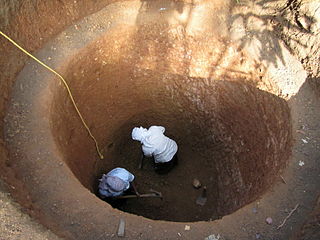
By Vaikoovery (Own work)

Genesis 26:17-33 (CEV)

17 Isaac left and settled in Gerar Valley, 18 where he cleaned out those wells that the Philistines had stopped up. Isaac also gave each of the wells the same name that Abraham had given to them. 19 While his servants were digging in the valley, they found a spring-fed well. 20 But the shepherds of Gerar Valley quarreled with Isaac’s shepherds and claimed the water belonged to them. So the well was named “Quarrel,” because they had quarreled with Isaac.

21 Isaac’s servants dug another well, and the shepherds also quarreled about it. So that well was named “Jealous.” 22 Finally, they dug one more well. There was no quarreling this time, and the well was named “Lots of Room,” because the Lord had given them room and would make them very successful.

23 Isaac went on to Beersheba, 24 where the Lord appeared to him that night and told him, “Don’t be afraid! I am the God who was worshiped by your father Abraham, my servant. I will be with you and bless you, and because of Abraham I will give you many descendants.” 25 Isaac built an altar there and worshiped the Lord. Then he set up camp, and his servants started digging a well.

26 Meanwhile, Abimelech had left Gerar and was taking his advisor Ahuzzath and his army commander Phicol to see Isaac. 27 When they arrived, Isaac asked, “Why are you here? Didn’t you send me away because you hated me?”

28 They answered, “We now know for certain that the Lord is with you, and we have decided there needs to be a peace treaty between you and us. So let’s make a solemn agreement 29 not to harm each other. Remember, we have never hurt you, and when we sent you away, we let you go in peace. The Lord has truly blessed you.”

30 Isaac gave a big feast for them, and everyone ate and drank. 31 Early the next morning Isaac and the others made a solemn agreement, then he let them go in peace.

32 Later that same day Isaac’s servants came and said, “We’ve struck water!” 33 So Isaac named the well Shibah, and the town is still called Beersheba.

And so the journey continues.  Isaac takes up the journeying after the death of his father, Abraham as he had become by then.  Still moving, still following God.

But moving on meant fitting in with new people, sharing their resources.  It appears that even if you bring help, you’re not always welcome.  I was interested in Maggi’s point that the Philistines themselves were probably ‘incomers’ too (p48), so maybe they should have been more welcoming, or maybe they thought they had even more to lose because of it.

This is one element of journeying that is hard.  You arrive ready, in fact needing, to make new friends and to find a place to fit in.  But in the place you come to, people already have friends, the jobs are all taken.  It can be hard to slip in and find your place.

But new people bring something valuable.  New perspective, new skills, fresh ideas.  That can be frightening to those who are already there.  Will I not be needed any more?  But in God’s ways there is “lots of room”.  So, do we welcome new people?  Do we ‘let them in’, share their skills, their discoveries, ideas that may widen our horizon and enrich our journey?  Or are we territorial, jealous and angry?

For our journey is not a solitary one.  There are companions on the way and people we encounter in the places we come to.  God has been there before us, and will be there when we move on, as he is with those who arrive in our valley.  We cannot claim anything as “ours”.  It is God’s and we are invited to share with him and with others.

At the end, an agreement is made,

So let’s make a solemn agreement not to harm each other

That’s not a bad agreement to live by 🙂  Not just in terms of physical harm, but emotional and spiritual too.  Letting others in, welcoming what they have to share, accepting their gifts, allowing them to show us more of God – unstopping the wells that others have blocked up…

As Maggi points out, there is a skill, and dare I say it, a ministry, in

He didn’t pick a fight with the surround culture, but neither did he allow it to subsume him.  he continued to dig in all the places his father had taught him. (p49)

She also shares some more important lessons for the church from this passage.

The Presence of the Lord is Moving in this Place

Thank you Lord,
for the people
I meet
along the way.

Those who have so much
to teach me,
to show me,
to enrich my life,
to open up the stopped up places.

Those who I can share with,
give to,
welcome,
and live in peace with.

Thank you that you are
the God of
‘Lots of Room’.
Room for us all,
room for all.

This year, several of us are reading Beginnings and Endings by Maggi Dawn and joining together to comment on it.  Do join us at the Adventbookclub Facebook page, follow #adventbookclub on Twitter or comment below.  If you are also reading and blogging on this book, let me know and I will link to your blog.