Jesus was taken away, 17 and he carried his cross to a place known as “The Skull.” In Aramaic this place is called “Golgotha.” 18 There Jesus was nailed to the cross, and on each side of him a man was also nailed to a cross.
19 Pilate ordered the charge against Jesus to be written on a board and put above the cross. It read, “Jesus of Nazareth, King of the Jews.” 20 The words were written in Hebrew, Latin, and Greek.
The place where Jesus was taken wasn’t far from the city, and many of the Jewish people read the charge against him. 21 So the chief priests went to Pilate and said, “Why did you write that he is King of the Jews? You should have written, ‘He claimed to be King of the Jews.’”
22 But Pilate told them, “What is written will not be changed!”
23 After the soldiers had nailed Jesus to the cross, they divided up his clothes into four parts, one for each of them. But his outer garment was made from a single piece of cloth, and it did not have any seams. 24 The soldiers said to each other, “Let’s not rip it apart. We will gamble to see who gets it.” This happened so that the Scriptures would come true, which say,
“They divided up my clothes and gambled for my garments.”
The soldiers then did what they had decided.
25 Jesus’ mother stood beside his cross with her sister and Mary the wife of Clopas. Mary Magdalene was standing there too. 26 When Jesus saw his mother and his favorite disciple with her, he said to his mother, “This man is now your son.” 27 Then he said to the disciple, “She is now your mother.” From then on, that disciple took her into his own home.
I’ve no idea, why they brought him to me. Probably trying to get me to do their dirty work, make it all official. They wanted rid of him, and I was the person they thought would do it.
But I couldn’t do anything. The rules they insisted he’d broken were religious ones, not ones I could deal with.
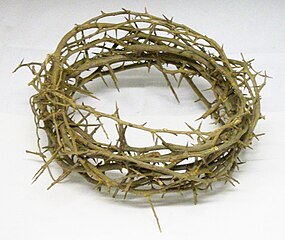
They were brutal with him. Who wants thorns pressing into their skin? Being beaten, whipped – such physical mocking. Then not content with that they put a purple robe on him too. Total public humiliation.
I tried again. To get them to see sense, realise I could condemn him of nothing.
But they were having none of it. Nothing was going to satisfy them. They were baying for blood – and determined to get it. This poor man. He really had done nothing wrong. But he’d obviously made some influential people very angry.
They insisted they were Jewish laws that he’d broken. What could I do?
I wanted to free him. I tried to give them a get out clause, but they were having none of it.
19 Pilate gave orders for Jesus to be beaten with a whip. 2 The soldiers made a crown out of thorn branches and put it on Jesus. Then they put a purple robe on him. 3 They came up to him and said, “Hey, you king of the Jews!” They also hit him with their fists.
4 Once again Pilate went out. This time he said, “I will have Jesus brought out to you again. Then you can see for yourselves that I have not found him guilty.”
5 Jesus came out, wearing the crown of thorns and the purple robe. Pilate said, “Here is the man!”
6 When the chief priests and the temple police saw him, they yelled, “Nail him to a cross! Nail him to a cross!”
Pilate told them, “You take him and nail him to a cross! I don’t find him guilty of anything.”
7 The crowd replied, “He claimed to be the Son of God! Our Jewish Law says that he must be put to death.”
8 When Pilate heard this, he was terrified. 9 He went back inside and asked Jesus, “Where are you from?” But Jesus did not answer.
10 “Why won’t you answer my question?” Pilate asked. “Don’t you know that I have the power to let you go free or to nail you to a cross?”
11 Jesus replied, “If God had not given you the power, you couldn’t do anything at all to me. But the one who handed me over to you did something even worse.”
12 Then Pilate wanted to set Jesus free. But the crowd again yelled, “If you set this man free, you are no friend of the Emperor! Anyone who claims to be a king is an enemy of the Emperor.”
13 When Pilate heard this, he brought Jesus out. Then he sat down on the judge’s bench at the place known as “The Stone Pavement.” In Aramaic this pavement is called “Gabbatha.” 14 It was about noon on the day before Passover, and Pilate said to the crowd, “Look at your king!”
15 “Kill him! Kill him!” they yelled. “Nail him to a cross!”
“So you want me to nail your king to a cross?” Pilate asked.
The chief priests replied, “The Emperor is our king!” 16 Then Pilate handed Jesus over to be nailed to a cross.
She gave her everything,
now Jesus is giving his everything.
He,
God here among us,
King of all kings,
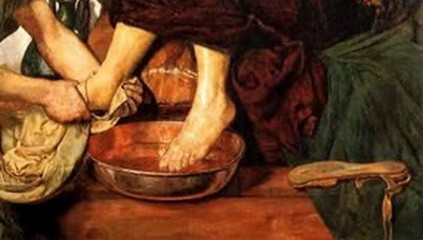
kneels
at our feet
and gently,
tenderly,
lovingly,
washes them.
Soothes them,
cleans them,
deals with the cuts and blisters,
gently pats them dry.
~~~
Our feet,
as wandering disciples
had been the tools of our trade,
what took us with him,
the sign of our following
and wanting to be with them.
He stoops
to bring refreshment,
healing,
the ability to go further.
How can I let him do this?
Surely I should be washing his feet,
showing my service to him.
But no,
he wants to tend me,
restore me,
refresh me.
To not let him
is to turn my back on him,
to all he offers me.
He wants me
to learn to tend others,
and like with everything else,
he shows me the way.
His way,
the on your knees way,
the not afraid of dirt way,
the not too great for this way.
Lord,
may I learn
and live
as a washer,
a kneeler,
a restorer
in you.
13 It was before Passover, and Jesus knew that the time had come for him to leave this world and to return to the Father. He had always loved his followers in this world, and he loved them to the very end.
2 Even before the evening meal started, the devil had made Judas, the son of Simon Iscariot, decide to betray Jesus.
3 Jesus knew that he had come from God and would go back to God. He also knew that the Father had given him complete power. 4 So during the meal Jesus got up, removed his outer garment, and wrapped a towel around his waist. 5 He put some water into a large bowl. Then he began washing his disciples’ feet and drying them with the towel he was wearing.
6 But when he came to Simon Peter, that disciple asked, “Lord, are you going to wash my feet?”
7 Jesus answered, “You don’t really know what I am doing, but later you will understand.”
8 “You will never wash my feet!” Peter replied.
“If I don’t wash you,” Jesus told him, “you don’t really belong to me.”
9 Peter said, “Lord, don’t wash just my feet. Wash my hands and my head.”
10 Jesus answered, “People who have bathed and are clean all over need to wash just their feet. And you, my disciples, are clean, except for one of you.”11 Jesus knew who would betray him. That is why he said, “except for one of you.”
12 After Jesus had washed his disciples’ feet and had put his outer garment back on, he sat down again. Then he said:
Do you understand what I have done? 13 You call me your teacher and Lord, and you should, because that is who I am. 14 And if your Lord and teacher has washed your feet, you should do the same for each other. 15 I have set the example, and you should do for each other exactly what I have done for you. 16 I tell you for certain that servants are not greater than their master, and messengers are not greater than the one who sent them. 17 You know these things, and God will bless you, if you do them.
18 I am not talking about all of you. I know the ones I have chosen. But what the Scriptures say must come true. And they say, “The man who ate with me has turned against me!” 19 I am telling you this before it all happens. Then when it does happen, you will believe who I am. 20 I tell you for certain that anyone who welcomes my messengers also welcomes me, and anyone who welcomes me welcomes the one who sent me.




 Pam's Perambulation