
Back Home

•January 30, 2013 • Leave a Comment

You know what its like, the place you grew up.  The people who saw all the mistakes you made, heard the stupid things you said, the bold claims you made…

I did a fair bit of that in my time.  I wonder how those people would view me now?

One of the potentially scary things about Facebook and the like, is that people can catch up with you (I suppose you may be reading this having known me as that brash teenager who lived in a world where issues were so easily either black or white… If so, sorry)  The internet makes it no longer so easy to leave our past behind, however far we have travelled.
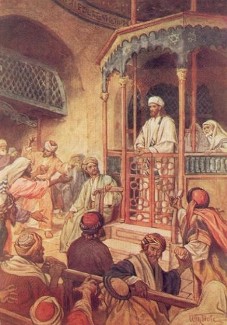
By William Hole [Public domain], via Wikimedia Commons

So Jesus has been working in Galilee, doing some good stuff, and everyone is very pleased with him.  Then he goes “back home” to Nazareth, and they’re not quite so pleased to see him.  As hinted at last week, they very quickly turn against him.

Luke 4:21-30

21 Then Jesus said to them, “What you have just heard me read has come true today.”

22 All the people started talking about Jesus and were amazed at the wonderful things he said. They kept on asking, “Isn’t he Joseph’s son?”

23 Jesus answered:

You will certainly want to tell me this saying, “Doctor, first make yourself well.” You will tell me to do the same things here in my own hometown that you heard I did in Capernaum. 24 But you can be sure that no prophets are liked by the people of their own hometown.

25 Once during the time of Elijah there was no rain for three and a half years, and people everywhere were starving. There were many widows in Israel, 26 but Elijah was sent only to a widow in the town of Zarephath near the city of Sidon. 27 During the time of the prophet Elisha, many men in Israel had leprosy. But no one was healed, except Naaman who lived in Syria.

28 When the people in the meeting place heard Jesus say this, they became so angry 29 that they got up and threw him out of town. They dragged him to the edge of the cliff on which the town was built, because they wanted to throw him down from there. 30 But Jesus slipped through the crowd and got away.

Jesus has come to tell them what he’s all about – what God is all about, and all they can think about is who he is.  “We know you”, “We remember you growing up round here”, “You’re Joseph’s son”.  They couldn’t see his message because they were so tied up with who they thought he was.  They got so angry, they threw him out and dragged him away.  That is quite a response.

I wonder why they reacted to Jesus that way?  Did they think he had ideas above his station?  Did they think he was lying?  Or mocking them?  Could they just not see beyond the person they thought he was and accept he had something to share with them?

How would we react in that situation?  How many times do we miss what God is trying to show us because we cannot see past what we think of the person who is telling us – our pre-conceptions, misunderstandings and biases?

I wonder…

Last Sundays Songs of Praise had an interview with a Christian Goth, who has had some interesting responses by people.  A Goth and a Christian – “you can’t do that!”

Lord,

may my ability to hear your word

not be hampered

by my inability to hear who is saying it.

May I lay aside

my preconceptions,

my rememberings,

what I think I know,

and be open to hear your voice

even in places where I don’t expect to,

and from people I don’t expect to.

Lord,

please,

may I never drive out

those who bring your word

In Love

•January 29, 2013 • 4 Comments

By Wingman Gerald Green (Own work) [CC-BY-3.0 (http://creativecommons.org/licenses/by/3.0)%5D, via Wikimedia Commons

1 Corinthians 13:1-13

Love

13 What if I could speak
all languages
of humans
and of angels?
If I did not love others,
I would be nothing more
than a noisy gong
or a clanging cymbal.
What if I could prophesy
and understand all secrets
and all knowledge?
And what if I had faith
that moved mountains?
I would be nothing,
unless I loved others.
What if I gave away all
that I owned
and let myself
be burned alive?
I would gain nothing,
unless I loved others.
Love is kind and patient,
never jealous, boastful,
proud, or rude.
Love isn’t selfish
or quick tempered.
It doesn’t keep a record
of wrongs that others do.
Love rejoices in the truth,
but not in evil.
Love is always supportive,
loyal, hopeful,
and trusting.
Love never fails!

Everyone who prophesies
will stop,
and unknown languages
will no longer
be spoken.
All that we know
will be forgotten.
We don’t know everything,
and our prophecies
are not complete.
10 But what is perfect
will someday appear,
and what isn’t perfect
will then disappear.

11 When we were children,
we thought and reasoned
as children do.
But when we grew up,
we quit our childish ways.
12 Now all we can see of God
is like a cloudy picture
in a mirror.
Later we will see him
face to face.
We don’t know everything,
but then we will,
just as God completely
understands us.
13 For now there are faith,
hope, and love.
But of these three,
the greatest is love.

This has to be one of the best know passages in the bible.  Read at many a wedding.

1 Corinthians has been working its way through the many and varied gifts we all have, and how each one has a vital part to play.

Now, having established that, we come to the reality that any of them are no use whatsoever if they do not have their basis in love.  Whether we can prophecy, work miracles, have huge faith, clean the church, visit the sick, clear the snow, or any other gift we exercise, it is as nothing if it is not done in and through love.

Love gives and gives on giving.  It doesn’t drum its fingers in impatience; stand around waiting for the ‘right’ response; do the right thing with the wrong attitude; wait for others to trip up to look better; keep a score card…

Love is always supportive, loyal, hopeful,and trusting (v7)

How we all need some more of love like that – the kind of love that God offers.

Lord

I pray for love

– your kind of love,

to be in me.

That all I do

may be done for no more

and no less

than love

– your love

Excuses

•January 28, 2013 • 8 Comments

So someone asks you to do something.  But you’re not sure it’s for you.  It seems scary.  You’re not convinced you can do it.  And yet…

… you are asked

By Firmin Baes (Art Renewal Center) [Public domain], via Wikimedia Commons
Before you were born, I chose you…

Last nights episode of the fabulous Call the Midwife had a side story of calling, following it, and it’s effects.

Of course she’s got to go, she’s got a calling

And now we have Jeremiah:

Jeremiah 1:4-10

The Lord Chooses Jeremiah

The Lord said:

“Jeremiah, I am your Creator,
and before you were born,
I chose you to speak for me
to the nations.”

I replied, “I’m not a good speaker, Lord, and I’m too young.”

“Don’t say you’re too young,” the Lord answered. “If I tell you to go and speak to someone, then go! And when I tell you what to say, don’t leave out a word! 8

The Lord reached out his hand, then he touched my mouth and said, “I am giving you the words to say, 10 and I am sending you with authority to speak to the nations for me. You will tell them of doom and destruction, and of rising and rebuilding again.”

God has chosen Jeremiah.  He has called him to speak for him.

Jeremiah is not sure…

There are good reasons Lord, why you wouldn’t choose me

I’m not a good speaker – and I’m too young anyway.

They are excuses!

God has called.  God will give the words to say.  Jeremiah goes, not in his own strength and power, but Gods.  There is a message to bring – and Jeremiah is the man to do it.  God had chosen him, long before he was born.

God calls to us.

Does that worry us? Scare us?  Make us feel inadequate?  Overwhelmed?  Under-prepared?

How shall we respond?

I remember when I was “invited” to consider becoming a local preacher.  I could not contemplate even writing a sermon.  By nature I am a scientist/mathematician, stringing words together in a coherent sentence with the correct structure was terrifying and seemed impossible (you may have noticed that!).  I am a child of my generation when creative writing was not taught, but just expected to happen – and certainly never corrected if it was wrong.  Although I have always loved reading, writing is just not my “thing”.  How could I write enough words to make up a sermon?

I was persuaded to give it a try.  I genuinely set about writing my first sermon expecting it to be my last, no idea how I would do it.   I still have no idea where the words come from, but come they do, purely, I believe, because it was what God was asking of me.  The amazing thing that happened was that first day, I turned up with a sermon written on the Old Testament reading (against all the rules!), about the plea for materials to build the Temple, to a church that had just had a quinquennial report saying the gable end was in need of major repair and they needed to launch a building scheme…  OK God, so I get your point.

And if God can do that in me, he must be able to do it in anyone.

God has many tasks to be done, as we have seen in recent weeks readings.  There are many ways to speak for him – not all are preaching in church.

I don’t know what God is asking of you today, but I can guarantee that if he has calls, he is equips.

Whatever reservations we have about ourselves, God doesn’t.  He has chosen you for a task because you are the one who can do it.  And he assures you that he will give you the words you need when you need them.

Today, this is his word to you:

 I promise to be with you and keep you safe, so don’t be afraid.

I thank you Lord,

that you call to me,

to work with you,

and speak for you.

Even though it scares me,

I feel inadequate,

I’m not sure that’s me…

Lord,

as I respond,

hesitantly,

carefully,

fearfully;

I thank you

that you have chosen me,

and promise to be with me

and keep me safe