
Dangerous Love

•March 1, 2013 • 5 Comments

Stephen Cottrell reminds us that the second place where scorpions are mentioned in the gospels is in  Luke 10:17-19

The Return of the Seventy-Two

17 When the seventy-two followers returned, they were excited and said, “Lord, even the demons obeyed when we spoke in your name!”

18 Jesus told them:

I saw Satan fall from heaven like a flash of lightning. 19 I have given you the power to trample on snakes and scorpions and to defeat the power of your enemy Satan. Nothing can harm you.

Ah, so I wasn’t so wrong in my first assessment of the picture!

Jesus does not subdue the scorpion, but loves it.  For Jesus that means he has accepted God’s will, he can hold the thing that might kill him.  Cottrell suggests that the scorpion and the daisies are the two sides of one coin.  The ability to love one must include that ability to love the other (p60).  Powerful stuff!

Love

43 You have heard people say, “Love your neighbors and hate your enemies.” 44 But I tell you to love your enemies and pray for anyone who mistreats you. 45 Then you will be acting like your Father in heaven. He makes the sun rise on both good and bad people. And he sends rain for the ones who do right and for the ones who do wrong.

Am I more picky in who and what I choose to love?  Do I only want the nice parts of life, without accepting the harder parts?  Am I selective with my love?  Loving only the easy to love, and not the dangerous?

By Wingchi Poon (Own work) [CC-BY-SA-3.0 (http://creativecommons.org/licenses/by-sa/3.0)%5D, via Wikimedia Commons

These thoughts are reflecting on Spencer’s painting The Scorpion (seen here at the bottom of the second page).

This year for Lent, I am reading Christ in the Wilderness by Bishop Stephen Cottrell, published by SPCK, reflecting on Stanley Spencer’s paintings of that title.

I’m not necessarily going to blog every day on it, just when something leaps out at me – and they will be thoughts rather than full blog posts
Calling

•February 28, 2013 • Leave a Comment

Well there’s nothing like discovering you have got hold of the wrong end of the stick!  Seems I read this picture totally wrong – though I was always told in college that “there are many meanings”…

Stephen Cottrell aligns this picture with Luke 11:11-12,

11 Which one of you fathers would give your hungry child a snake if the child asked for a fish? 12 Which one of you would give your child a scorpion if the child asked for an egg?

The suggestion, that God will indeed give his son a scorpion when he is craving food (p58).

This picture is quite clearly wilderness.   Gone are the green grass, the tall trees and the blooming flowers of Consider the Lilies.  This is a brown, barren landscape.  Cottrell suggests,

He is asked to receive the thing he fears, the thing that could kill him (p59)

That pretty much sums up where Jesus’ life was heading, once he left the wilderness of temptation.  Will he take up his calling?

And for us?  What do we struggle with?  What is our calling?  Can we take it up?  Or will we drop it and run?

These thoughts are reflecting on Spencer’s painting The Scorpion (seen here at the bottom of the second page).

This year for Lent, I am reading Christ in the Wilderness by Bishop Stephen Cottrell, published by SPCK, reflecting on Stanley Spencer’s paintings of that title.

I’m not necessarily going to blog every day on it, just when something leaps out at me – and they will be thoughts rather than full blog posts
Bearing Fruit?

•February 28, 2013 • 1 Comment

In our garden, we have a miniature pear tree.  It has been there now for four years, and has never yet produced any blossom, never mind any fruit.  I wonder how long I have to give it, how long it gets to take up space without giving anything back, or earning its keep.

At the moment it looks very bedraggled on a cold, wet winters day, but I live in hope.  Maybe this year…

2013-02-25 09.30.34

Luke 13:1-9

Turn Back to God

13 About this same time Jesus was told that Pilate had given orders for some people from Galilee to be killed while they were offering sacrifices. Jesus replied:

Do you think that these people were worse sinners than everyone else in Galilee just because of what happened to them? Not at all! But you can be sure that if you don’t turn back to God, every one of you will also be killed. What about those eighteen people who died when the tower in Siloam fell on them? Do you think they were worse than everyone else in Jerusalem? Not at all! But you can be sure that if you don’t turn back to God, every one of you will also die.

A Story about a Fig Tree

Jesus then told them this story:

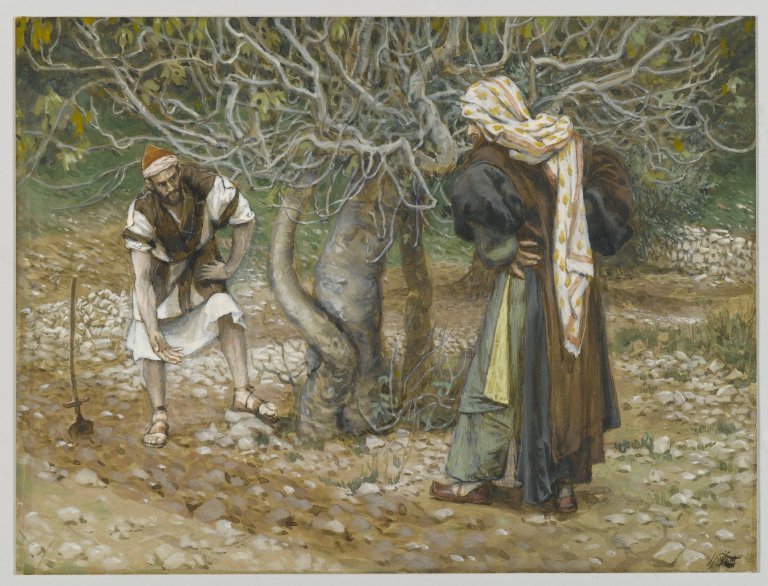
A man had a fig tree growing in his vineyard. One day he went out to pick some figs, but he didn’t find any. So he said to the gardener, “For three years I have come looking for figs on this tree, and I haven’t found any yet. Chop it down! Why should it take up space?”

The gardener answered, “Master, leave it for another year. I’ll dig around it and put some manure on it to make it grow. Maybe it will have figs on it next year. If it doesn’t, you can have it cut down.”

Jesus has come to implore the people to turn back to God.  Not because if they don’t God will be angry, but because he knows that God’s ways are the very best ways for people to live – the way to get the best, all that was intended, out of life.

As an aside, he gives us a pointer about suffering:

You know that tower that fell over, and killed eighteen people?  They were no worse than anyone else.  They didn’t die because they were worse sinners than everyone else.

Then Jesus tells them a story.

How annoyed would you be if your fig tree/pear tree/raspberry canes or any other produce were not bearing fruit – and had consistently failed to bear fruit for a number of years?  You would lose patience and uproot it, make room for something that was going to fruit.

Yet the gardener begs for another year, another opportunity to come good.

Jesus is well aware of when things have gone wrong, when expected fruit has not appeared.

He sees that in our lives too.  When we have not done what we could or should, when we have not reached the expected standard, when our lives are not bearing fruit.

There may be those who want to stop us, who want to cut us short.  BUT, God says there is another chance, another opportunity.

Yes, there will come a time when enough is enough, but for now, God says no.  Let’s give them every opportunity, every help, let’s see what happens.  There is more time.

I don’t know about you, but I’m glad God gives me another chance.  That he doesn’t want to cut me down now with the results I have, but gives me further opportunity to get it right – with his help.

So if you are feeling it’s all gone wrong, you’re not doing what you should, or you’re not worthy of your place in God’s orchard – God says let’s give it another go.  I’m here to help you, to nourish you, I’m not going to cut you down or throw you out.

Thank God for that.

Thank you Lord

for second, third, fourth and more chances.

Thank you that you do not want us cut down

and thrown away,

but want us to succeed.

Thank you that we are not left alone to do that,

but you seek to nourish us

and help us grow.

Lord,

I long to produce fruit for you,

help me

I pray