
Maundy Thursday – In The Night Garden

•March 28, 2013 • Leave a Comment

Seized in the Garden at Night

18 Jesus, having prayed this prayer, left with his disciples and crossed over the brook Kidron at a place where there was a garden. He and his disciples entered it.

2-4 Judas, his betrayer, knew the place because Jesus and his disciples went there often. So Judas led the way to the garden, and the Roman soldiers and police sent by the high priests and Pharisees followed. They arrived there with lanterns and torches and swords. Jesus, knowing by now everything that was coming down on him, went out and met them. He said, “Who are you after?”

They answered, “Jesus the Nazarene.”

5-6 He said, “That’s me.” The soldiers recoiled, totally taken aback. Judas, his betrayer, stood out like a sore thumb.

Jesus asked again, “Who are you after?”

They answered, “Jesus the Nazarene.”

8-9 “I told you,” said Jesus, “that’s me. I’m the one. So if it’s me you’re after, let these others go.” (This validated the words in his prayer, “I didn’t lose one of those you gave.”)

10 Just then Simon Peter, who was carrying a sword, pulled it from its sheath and struck the Chief Priest’s servant, cutting off his right ear. Malchus was the servant’s name.

11 Jesus ordered Peter, “Put back your sword. Do you think for a minute I’m not going to drink this cup the Father gave me?”

12-14 Then the Roman soldiers under their commander, joined by the Jewish police, seized Jesus and tied him up. They took him first to Annas, father-in-law of Caiaphas. Caiaphas was the Chief Priest that year. It was Caiaphas who had advised the Jews that it was to their advantage that one man die for the people.

15-16 Simon Peter and another disciple followed Jesus. That other disciple was known to the Chief Priest, and so he went in with Jesus to the Chief Priest’s courtyard. Peter had to stay outside. Then the other disciple went out, spoke to the doorkeeper, and got Peter in.

17 The young woman who was the doorkeeper said to Peter, “Aren’t you one of this man’s disciples?”

He said, “No, I’m not.”

18 The servants and police had made a fire because of the cold and were huddled there warming themselves. Peter stood with them, trying to get warm.

Maundy Thursday – Humility and Love

•March 28, 2013 • Leave a Comment

Washing His Disciples’ Feet

13 1-2 Just before the Passover Feast, Jesus knew that the time had come to leave this world to go to the Father. Having loved his dear companions, he continued to love them right to the end. It was suppertime. The Devil by now had Judas, son of Simon the Iscariot, firmly in his grip, all set for the betrayal.

3-6 Jesus knew that the Father had put him in complete charge of everything, that he came from God and was on his way back to God. So he got up from the supper table, set aside his robe, and put on an apron. Then he poured water into a basin and began to wash the feet of the disciples, drying them with his apron. When he got to Simon Peter, Peter said, “Master, you wash my feet?”

Jesus answered, “You don’t understand now what I’m doing, but it will be clear enough to you later.”

Peter persisted, “You’re not going to wash my feet—ever!”

Jesus said, “If I don’t wash you, you can’t be part of what I’m doing.”

“Master!” said Peter. “Not only my feet, then. Wash my hands! Wash my head!”

10-12 Jesus said, “If you’ve had a bath in the morning, you only need your feet washed now and you’re clean from head to toe. My concern, you understand, is holiness, not hygiene. So now you’re clean. But not every one of you.” (He knew who was betraying him. That’s why he said, “Not every one of you.”) After he had finished washing their feet, he took his robe, put it back on, and went back to his place at the table.

12-17 Then he said, “Do you understand what I have done to you? You address me as ‘Teacher’ and ‘Master,’ and rightly so. That is what I am. So if I, the Master and Teacher, washed your feet, you must now wash each other’s feet. I’ve laid down a pattern for you. What I’ve done, you do. I’m only pointing out the obvious. A servant is not ranked above his master; an employee doesn’t give orders to the employer. If you understand what I’m telling you, act like it—and live a blessed life.

A New Command

31-32 When he had left, Jesus said, “Now the Son of Man is seen for who he is, and God seen for who he is in him. The moment God is seen in him, God’s glory will be on display. In glorifying him, he himself is glorified—glory all around!

33 “Children, I am with you for only a short time longer. You are going to look high and low for me. But just as I told the Jews, I’m telling you: ‘Where I go, you are not able to come.’

34-35 “Let me give you a new command: Love one another. In the same way I loved you, you love one another. This is how everyone will recognize that you are my disciples—when they see the love you have for each other.”

Wednesday of Holy Week – Betrayal

•March 27, 2013 • Leave a Comment

21 After he said these things, Jesus became visibly upset, and then he told them why. “One of you is going to betray me.”

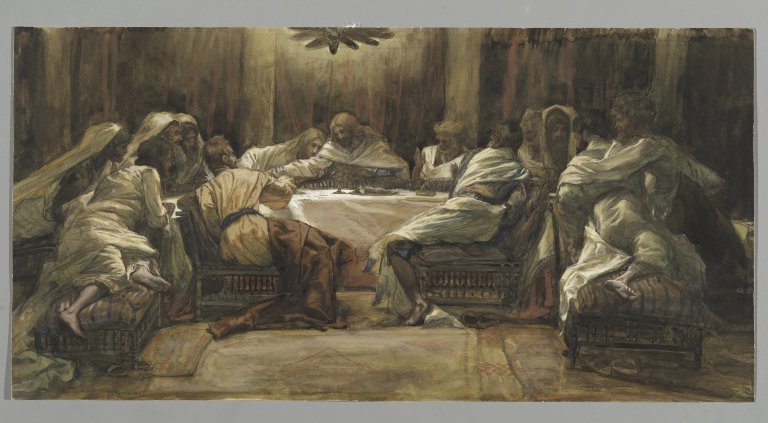
22-25 The disciples looked around at one another, wondering who on earth he was talking about. One of the disciples, the one Jesus loved dearly, was reclining against him, his head on his shoulder. Peter motioned to him to ask who Jesus might be talking about. So, being the closest, he said, “Master, who?”

26-27 Jesus said, “The one to whom I give this crust of bread after I’ve dipped it.” Then he dipped the crust and gave it to Judas, son of Simon the Iscariot. As soon as the bread was in his hand, Satan entered him.

“What you must do,” said Jesus, “do. Do it and get it over with.”

28-29 No one around the supper table knew why he said this to him. Some thought that since Judas was their treasurer, Jesus was telling him to buy what they needed for the Feast, or that he should give something to the poor.

30 Judas, with the piece of bread, left. It was night.

A New Command

31-32 When he had left, Jesus said, “Now the Son of Man is seen for who he is, and God seen for who he is in him. The moment God is seen in him, God’s glory will be on display. In glorifying him, he himself is glorified—glory all around!