I came to this book first of all because it is shortlisted for the Man Booker Prize 2013, something I always take interest in as a way of finding new and challenging books to read – in my humble opinion it rarely disappoints, there are always some gems in there.
Then, of course, this caught my eye because of its biblical links.
The Testament of Mary is an imagining of the events surrounding Jesus life and death from the eyes of his mother. Some of it based around the legend of Mary living in exile in Ephesus after Jesus’ death, some of it focusses on her life with Jesus and her fears for him as his ministry unfolds.
For me, perhaps not unsurprisingly, the most powerful part is her witnessing of and perspective on his death. These parts would be very usable at a Good Friday service to bring a different slant to the narrative.
Having said that, the rest of the story gives food for thought. What would it have been like to be Jesus’ mother? If nothing else dangerous… What thoughts would have gone through her mind? How do you carry on after such a death of your child?
An all round interesting and thought-provoking read.
(Just one aside – this book’s claim to fame is to be the “Slimmest novel ever shortlisted” – my e-edition is 66 pages – but I believe the adage is quality over quantity!)
Have you ever waited for something to happen, expecting it to be spectacular? And in the end it has turned out to be very ordinary?
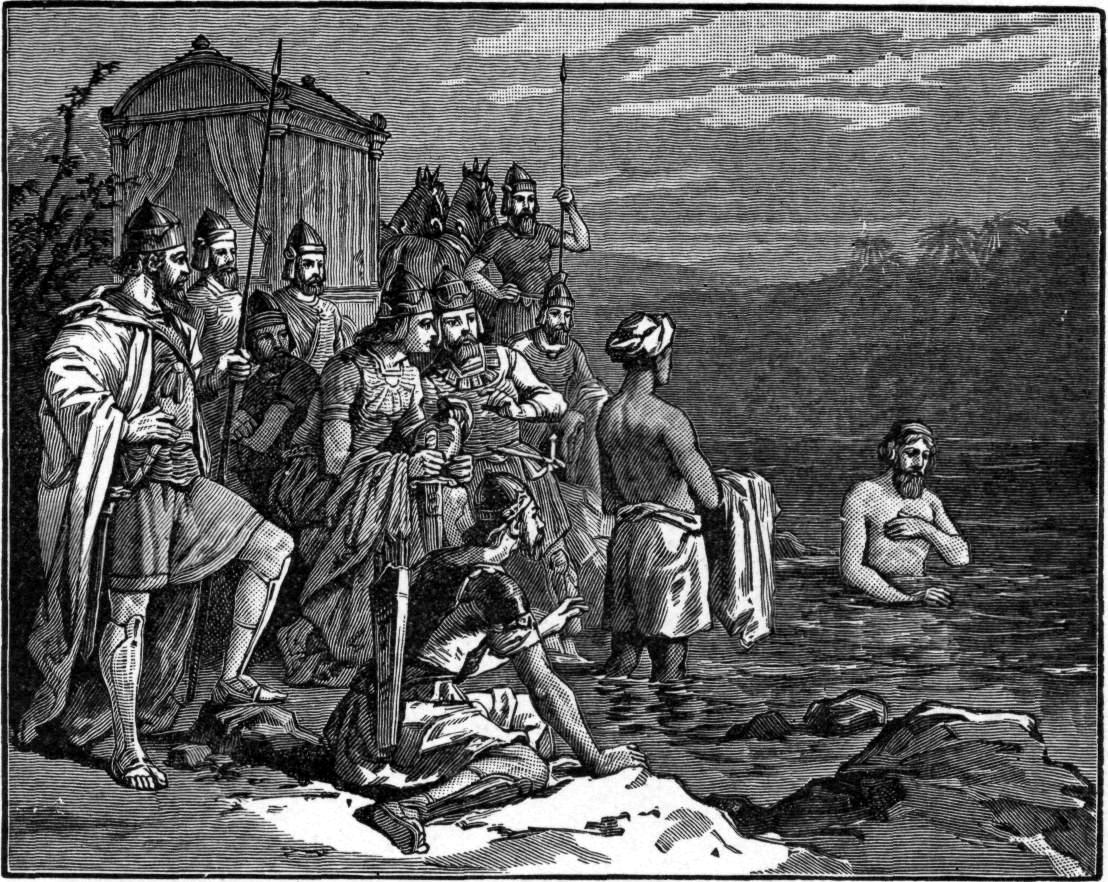
2 Kings 5:1-15 (CEV)
Elisha Heals Naaman
5 Naaman was the commander of the Syrian army. The Lord had helped him and his troops defeat their enemies, so the king of Syria respected Naaman very much. Naaman was a brave soldier, but he had leprosy.
2 One day while the Syrian troops were raiding Israel, they captured a girl, and she became a servant of Naaman’s wife. 3 Some time later the girl said, “If your husband Naaman would go to the prophet in Samaria, he would be cured of his leprosy.”
4 When Naaman told the king what the girl had said, 5 the king replied, “Go ahead! I will give you a letter to take to the king of Israel.”
Naaman left and took along seven hundred fifty pounds of silver, one hundred fifty pounds of gold, and ten new outfits. 6 He also carried the letter to the king of Israel. It said, “I am sending my servant Naaman to you. Would you cure him of his leprosy?”
7 When the king of Israel read the letter, he tore his clothes in fear and shouted, “That Syrian king believes I can cure this man of leprosy! Does he think I’m God with power over life and death? He must be trying to pick a fight with me.”
8 As soon as Elisha the prophet heard what had happened, he sent the Israelite king this message: “Why are you so afraid? Send the man to me, so that he will know there is a prophet in Israel.”
9 Naaman left with his horses and chariots and stopped at the door of Elisha’s house. 10 Elisha sent someone outside to say to him, “Go wash seven times in the Jordan River. Then you’ll be completely cured.”
11 But Naaman stormed off, grumbling, “Why couldn’t he come out and talk to me? I thought for sure he would stand in front of me and pray to the Lord his God, then wave his hand over my skin and cure me. 12 What about the Abana River or the Pharpar River? Those rivers in Damascus are just as good as any river in Israel. I could have washed in them and been cured.”
13 His servants went over to him and said, “Sir, if the prophet had told you to do something difficult, you would have done it. So why don’t you do what he said? Go wash and be cured.”
14 Naaman walked down to the Jordan; he waded out into the water and stooped down in it seven times, just as Elisha had told him. Right away, he was cured, and his skin became as smooth as a child’s.
15 Naaman and his officials went back to Elisha. Naaman stood in front of him and announced, “Now I know that the God of Israel is the only God in the whole world. Sir, would you please accept a gift from me?”
Naaman was looking for a grand gesture. He expected something spectacular. He wanted God to heal him in a very public and showy way. He felt cheated at having come all this way, and then just being told to wash in the river to be healed. He was not prepared for gentle ease which Elisha offered him. He wanted fireworks.
Are we sometimes guilty of looking for God only in the spectacular? Do we want him to do amazing things with us? Do we feel cheated and feel we’ve been offered a second best or substandard encounter with him when it is very ordinary? Do we notice God in the ordinary, or are we too busy looking for the flash?
There is a huge culture of the “Look at Me” prevalent in society. The emphasis on being spectacular, the centre of attention, even perhaps the one God is using/working in most. Sometimes, no often, all God is asking of us is the ordinary life. To be faithful in the everyday things. In reality, not much of life is spectacular (otherwise it wouldn’t be the spectacular, that would become the ordinary). When it is, it is amazing, but fortunately for us, God works just as much in the ordinary as he does in grand gestures.
God’s might and power are no less for working in the ordinary. To me it is much more powerful that he is in the unspectacular – because that is where I am.
God is God of the whole world – not just the showy and the flash – and I thank God for that.
Thank you Lord,
that though you do sometimes
work in spectacular ways,
that you are very much at work
in the ordinary and understated.
Thank you that you are God of the whole world,
the tiny details,
the day-to-day humdrum of life.
Lord,
may I not miss what you are doing,
by looking for the wrong thing,
in the wrong place.
Be in the ordinary in me Lord,
in my everything,
I pray
Thanks to Merry Lizard for writing a very helpful springboard post from this.
By Alex Proimos from Sydney, Australia (Taking the Plunge Together Uploaded by russavia) [CC-BY-2.0 (http://creativecommons.org/licenses/by/2.0)%5D, via Wikimedia Commons
I think faith is one of those things that everyone thinks everyone else’s is stronger, deeper, more alive…When the truth is we’re all getting on with it as best we can, and probably someone else is thinking the same about you!
Even the apostles asked for stronger faith – and they were there, in the flesh, with Jesus…
5 The apostles said to the Lord, “Make our faith stronger!”
6 Jesus replied:
If you had faith no bigger than a tiny mustard seed, you could tell this mulberry tree to pull itself up, roots and all, and to plant itself in the ocean. And it would!
7 If your servant comes in from ploughing or from taking care of the sheep, would you say, “Welcome! Come on in and have something to eat”? 8 No, you wouldn’t say that. You would say, “Fix me something to eat. Get ready to serve me, so I can have my meal. Then later on you can eat and drink.” 9 Servants don’t deserve special thanks for doing what they are supposed to do. 10 And that’s how it should be with you. When you’ve done all you should, then say, “We are merely servants, and we have simply done our duty.”
Jesus tells some strange stories. Some that appear at first glance to be quite heartless. This seems quite hard on the servants – but that was their job. In whatever our employment is, we expect to be given one task and another and another. We have a contract, there are expectations, a job to be done. You would not expect the MD to invite you in for coffee and a sit down every time you have completed one of your tasks. You just get on with the job you are employed to do.
Presumably this little tale is to explain about faith, and getting stronger faith. And Jesus is saying
Just get on with it!
Is having a stronger faith something God can do for us? Or something we get by doing stuff that requires faith? The more we use, the more we find we’ll have. Using faith grows faith. If we sit around waiting to have enough faith, we’ll never do anything, if we go out and do something, we may be surprised how much faith we have. We can stay home and pray for it – or get out and do it.
This passage follows on from the part about “how many times should I forgive my brother?” Perhaps knowing they need more faith comes from Jesus’ response to that. And in itself perhaps that is a prime example of doing not thinking. If we start thinking about how we can forgive someone, we will probably never get on with it. If we just do it, we might discover it is so much easier than we thought.
I was tempted to add a song praying for faith – but that seems at odds to what I’m saying…
So, instead I’ve gone for this
Lord,
sometimes it is not easy to understand the stories Jesus told.
we were not there,
we can’t see the look on his face,
or where they were at the time.
But we know we all long for more faith,
we want to know you more,
serve you better,
be sure of the way you’re calling us
– but sometimes we just have step out in faith
to trust you
and what we know of you.
So Lord,
as I long for more faith,
may I step out in your faith,
may I work with what I already know of you,
know that you won’t abandon me,
but love me.